
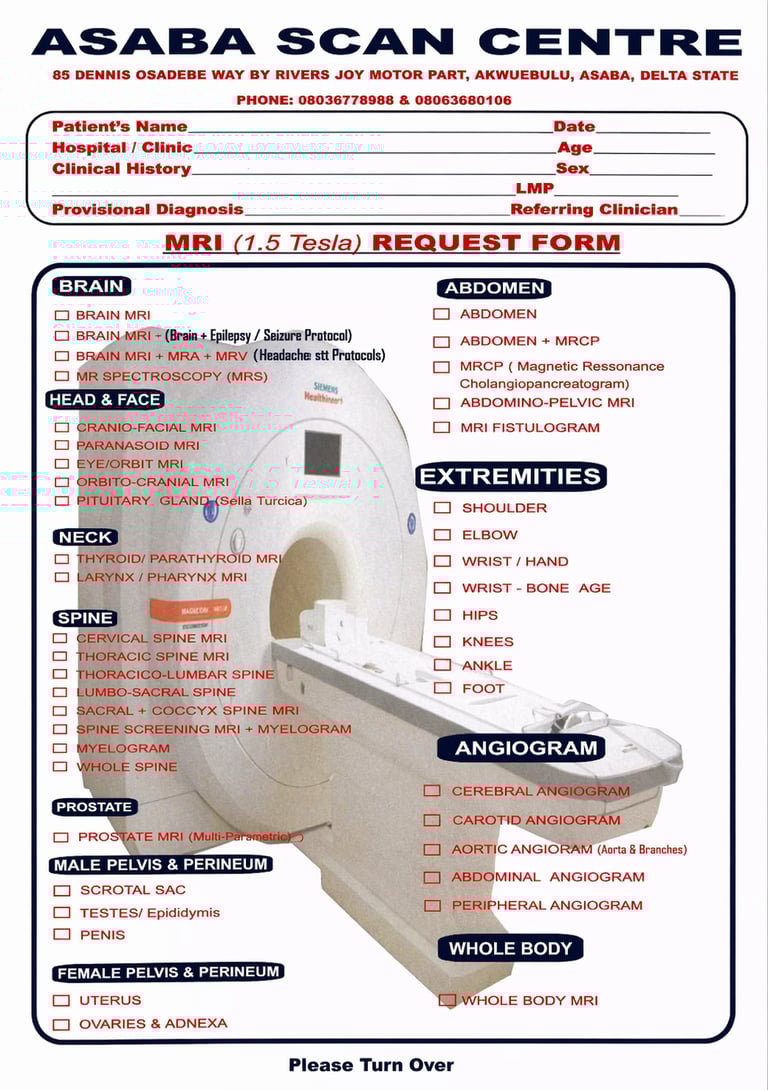
MRI (1.5 Tesla)
BRAIN
BRAIN MRI
BRAIN MRI (Brain + Epilepsy / Seizure Protocol)
BRAIN MRI (MRA + MRV (Headaches etc Protocols)
MR SPECTROSCOPY (MRS)
HEAD & FACE
CRANIO-FACIAL MRI
MASTOID MRI
EYE/ORBIT MRI
ORBITO-CRANIAL MRI
PITUITARY GLAND MRI (Sella Turcica)
NECK
THYROID/PARATHYROID MRI
LARYNX / PHARYNX MRI
SPINE
CERVICAL SPINE MRI
THORACIC SPINE MRI
THORACICO-LUMBAR SPINE MRI
LUMBO-SACRAL SPINE MRI
SACRAL & COCCYX SPINE MRI
SPINE SCREENING MRI + MYELOGRAM
MYELOGRAM
WHOLE SPINE MRI
ANGIOGRAM
CEREBRAL ANGIOGRAM
CAROTID ANGIOGRAM
AORTIC ANGIOGRAM (Aorta & Branches)
ABDOMINAL ANGIOGRAM
PERIPHERAL ANGIOGRAM
PROSTATE
PROSTATE MRI (Multi-parametric)
MALE PELVIS & PERINEUM
SCROTAL SAC MRI
TESTES / Epididymis MRI
PENIS MRI
FEMALE PELVIS & PERINEUM
UTERUS MRI
OVARIES & ADNEXA MRI
ABDOMEN
ABDOMEN MRI
ABDOMEN + MRCP
MRCP (Magnetic Resonance Cholangiopancreatogram)
ABDOMINO-PELVIC MRI
MRI FISTULOGRAM
EXTREMITIES
SHOULDER MRI
ELBOW MRI
WRIST / HAND MRI
WRIST - BONE AGE MRI
HIPS MRI
KNEES MRI
ANKLE MRI
FOOT MRI
WHOLE BODY
WHOLE BODY MRI


Patient undergoing Brain MRI
MRI (Magnetic Resonance Imaging):
Thi is a non-invasive imaging technique that uses strong magnetic fields and radio waves to generate detailed images of organs and tissues inside the body. It doesn't use ionizing radiation like X-rays or CT scans, making it safer for repeated use.
Here’s a breakdown of the types of MRI exams listed:
1. Brain MRI
Brain MRI provides detailed images of the brain and is used to identify conditions like tumors, stroke, brain injuries, infections, and neurological disorders like epilepsy.
Brain MRI with Epilepsy/Seizure Protocol: Specifically designed to look for areas in the brain that may be responsible for seizures.
Brain MRI + MRA + MRV: This combines MRI with Angiography (MRA) to examine blood vessels in the brain and MR Venography (MRV) to assess veins, useful for detecting issues like aneurysms, strokes, or venous problems.
MR Spectroscopy (MRS): A specialized MRI technique that can measure the chemical composition of tissues, often used for brain tumor diagnosis or metabolic diseases.
2. Head & Face MRI
MRI can also examine the head and face, including:
Cranio-facial MRI: Focuses on the skull, face, and jaw areas.
Ear/mastoid MRI: Looks at the inner ear and mastoid bone behind the ear.
Eye/orbit MRI: Examines the eyes and the surrounding structures.
Pituitary gland MRI: Focuses on the gland located at the base of the brain that controls hormones.
3. Neck MRI
Used to examine the structures of the neck, including the thyroid and parathyroid glands, lymph nodes, and surrounding tissues.
4. Spine MRI
Provides detailed images of the spine and its components (bones, discs, nerves). Used to diagnose herniated discs, spinal cord injuries, and other spinal disorders:
Cervical Spine MRI: Neck area of the spine.
Thoracic Spine MRI: Upper and mid-back region.
Lumbar/Sacral Spine MRI: Lower back and sacrum.
Myelogram: A special imaging procedure that looks at the spinal cord and nerves.
5. Abdomen & Pelvic MRI
Used to assess organs in the abdomen and pelvis, such as the liver, kidneys, bladder, and reproductive organs:
Abdominal MRI: For conditions related to abdominal organs.
Pelvic MRI: Used for female reproductive organs, bladder, and prostate in men.
MRI Fistulogram: A special scan for detecting abnormal connections (fistulas) between organs.
6. Prostate MRI
An MRI focused on the prostate gland, often used in the diagnosis of prostate cancer or other prostate conditions.
7. Male/Female Pelvis & Perineum MRI
Male Pelvis MRI: Focuses on the pelvic organs, including the prostate and testes.
Female Pelvis MRI: Focuses on female reproductive organs, such as the uterus, ovaries, and fallopian tubes.
8. Extremities MRI
MRI can be used to evaluate the arms, legs, and joints to diagnose injuries, tears, or other abnormalities:
Includes shoulder, elbow, wrist, knee, and ankle joint MRI exams.
9. Whole Body MRI
A comprehensive scan that provides detailed images of the entire body, often used for full health check-ups or cancer screening.
MRI is a powerful tool for diagnosing a wide range of conditions, particularly soft tissue issues that are difficult to detect with other imaging methods like X-rays or CT scans.
Get in touch
Address
85 Dennis Osadebe Way, Near RTC Motor Park, Akwuebulu Junction, Asaba, Delta State
Contacts
+234 8036778988
info@asabascan.com